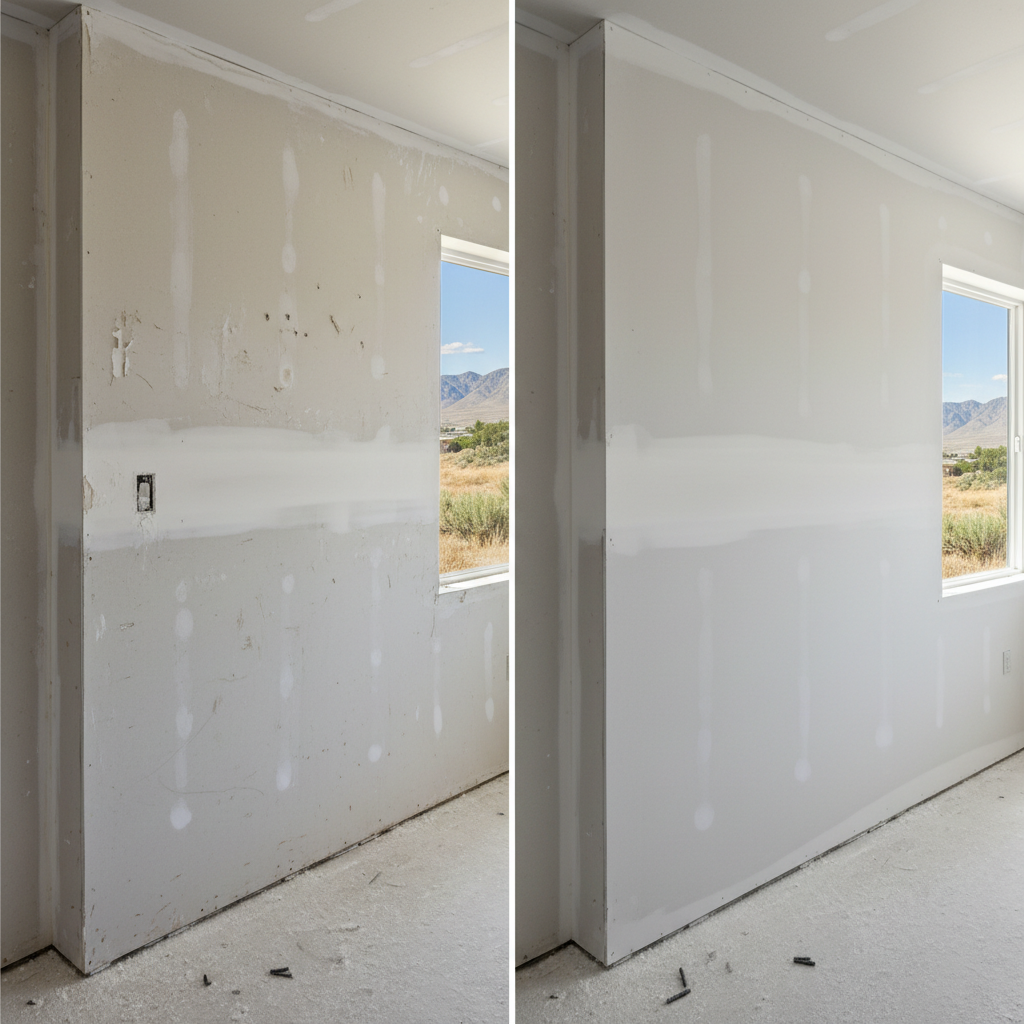
Alright, let's talk drywall finishes. Maybe you're building a new home, doing a renovation, or just patching up some old walls here in Orem. You've probably heard terms like 'taped and mudded' or 'Level 5 finish,' right? What's the big deal with these? Is one really better than the other? And, perhaps most importantly, which one makes the most sense for your place here in Utah?
As a local contractor, I've honestly seen it all — from the older homes in Canyon View to the brand-new builds up in Vineyard. The finish you pick isn't just about how it looks; it also hits your wallet, affects how long it lasts, and determines how much you'll notice every little flaw. So, let's dig in.
Taped and Mudded (Usually Level 3 or 4)
This is what most people picture when they say 'drywall.' It's pretty much the standard. We hang the sheets, tape the seams, and then put a few coats of joint compound (that's the 'mud') over those seams and screw heads. After that, we sand it down, and it's good to go for primer and paint.
- Cost: No doubt, this is the more budget-friendly choice. It takes less material and less labor. If you're trying to keep costs down, especially for a basement remodel or a rental property, this is usually the way to go.
- Durability: It's plenty tough for everyday life. The drywall itself provides the strength here. The finish holds up just fine to normal wear and tear.
- Maintenance: Patching is easy. If you get a ding or a hole, a little spackle, a quick sand, and some paint, and you're all set. Matching the texture can be the trickiest part, but it's generally straightforward.
- Appearance: This is where you really start to see the difference. With a standard taped and mudded finish, you'll probably notice some minor imperfections. This is especially true under certain lighting conditions. Think harsh natural light streaming through a big south-facing window, or a light shining directly down a wall. You might catch a slight 'shadow' where seams are, or a tiny bump. Most people don't even notice this unless they're really looking, or if the light hits it just right. For 90% of applications, it's a perfectly acceptable, smooth wall.
Level 5 Finish
Now, this is the Cadillac of drywall finishes. After we do all the taping and mudding, just like before, we then apply a very thin skim coat of joint compound over the *entire surface* of the drywall. Not just the seams, mind you, but every single square inch. Then it gets sanded super, super smooth.
- Cost: Expect to pay more, sometimes a lot more. It means a lot more labor and material. That extra skim coat and all that sanding takes time and skill, so for a whole house, this could add thousands to your project.
- Durability: The skim coat actually adds a very slight layer of protection to the paper face of the drywall. It makes the surface a bit harder and more uniform, which can help prevent minor scuffs from showing as easily.
- Maintenance: It's still pretty easy to patch, but you do need to be a bit more careful. You'll want to blend the patch into that perfectly smooth, skim-coated surface. It's not harder, just requires a little more finesse to keep that seamless look.
- Appearance: This is where Level 5 truly shines. It's as close to perfectly smooth and uniform as you can get. Those minor imperfections you might see with a standard finish? Gone. The entire wall surface is consistent. This is super important for walls that will have high-gloss paint, or in areas with critical lighting conditions – like a gallery wall or a room with lots of natural light reflecting off the surface. It looks incredibly crisp and clean.
Which One Should You Choose for Your Orem Home?
Here's my honest take. For most homes in Orem, a good quality taped and mudded finish (Level 3 or 4) is absolutely sufficient. It looks great, it's durable, and it's cost-effective. If you're painting with flat or eggshell paint, which most people do, those minor imperfections are rarely even noticeable.
However, there are definitely times when a Level 5 finish is worth that extra investment:
- High-end homes: If you're building a custom home and every single detail matters, Level 5 really delivers that premium look.
- Critical lighting: If you have big windows letting in a ton of natural light that will rake across a wall, or if you're planning on using accent lighting that shines directly on a wall, Level 5 will prevent those shadows from showing up.
- Glossy paint: If you're set on using a high-gloss or semi-gloss paint finish, Level 5 is almost a must-have. Those paints reflect so much light that every tiny imperfection will be highlighted.
- Minimalist design: For a very clean, minimalist aesthetic where the walls are a feature in themselves, Level 5 provides that flawless canvas.
Think about your budget, what you want the place to look like, and the type of paint you'll be using. For most bedrooms, living rooms, and general areas, a solid Level 3 or 4 finish from a reputable company like All Things Drywall Company will give you beautiful, smooth walls. But if you're chasing perfection, or have specific design needs, Level 5 is the way to go. Either way, getting it done right is key, so those walls look good for years to come, even with our dry Orem air.